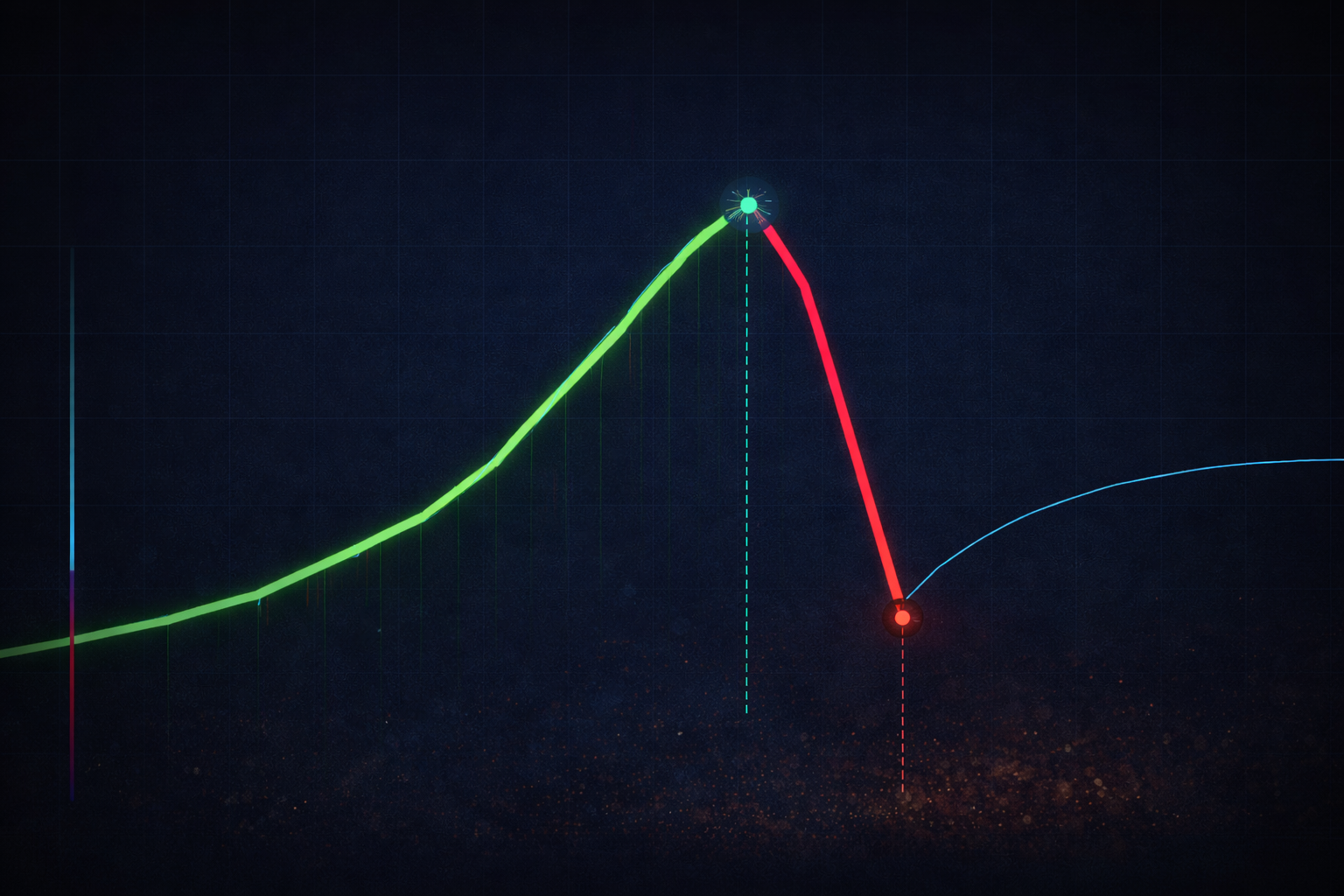
The Boom Creates The Bust.
A new academic paper just proved mathematically what every experienced trader already knows in their gut
There is a new paper put out by researchers at McMaster University in Canada that makes the case that the financial system’s reaction to crashes eventually makes everything WORSE.
What This Paper Actually Means for Traders
The Big Picture First
This paper builds a mathematical model that does something most academic finance refuses to do — it treats financial crashes as inevitable structural outcomes, not random surprises. As someone who’s traded through the dot-com collapse, 2008, COVID, and every liquidity squeeze in between, I can tell you this framing is far closer to reality than anything the efficient market crowd produces.
The authors are essentially formalizing what every seasoned trader already feels in their gut: debt drives speculation, speculation drives asset prices, and at some point the whole thing unwinds violently. Then the wreckage feeds back into the real economy and starts the cycle over.
The Core Idea: Two Economies Running Simultaneously
The model describes two interconnected worlds running in parallel:
World 1 — The Real Economy (wages, employment, business profits, bank loans)
World 2 — The Financial Market (asset prices, speculation, crash risk)
Most economists study these separately. Most traders only watch World 2. This paper says that’s a mistake — they are feeding each other constantly, and ignoring the connection is how you get blindsided.
The Feedback Loop That Creates Booms and Busts
Here’s the mechanism the model captures, and once you see it you’ll recognize it in every major market cycle you’ve ever lived through:
Step 1 — Credit Expands Banks create loans. Businesses borrow. The economy grows. Profits rise.
Step 2 — Speculation Begins Some of that borrowed money doesn’t go into productive investment — it goes into buying existing assets (stocks, real estate, art, crypto). The paper calls this the “speculative flow” (F). This is literally Minsky’s insight from the 1970s finally put into rigorous math.
Step 3 — Asset Prices Inflate More credit chasing existing assets pushes prices up. Rising prices attract more buyers. The feedback loop accelerates.
Step 4 — Crash Risk Quietly Builds Here’s the genius of the model: as speculative credit inflows increase, the probability of a sudden crash also increases proportionally. The authors model this as a “jump intensity” — essentially, the more levered the speculation, the higher the probability of a discontinuous price drop on any given day. The system is getting fragile even while it looks healthy.
Step 5 — The Crash The crash isn’t modeled as something that happens to the market from outside. It emerges from within the system. The jump happens. Prices gap down violently.
Step 6 — Banks Panic and Tighten Credit This is the critical transmission mechanism back to the real economy. When markets crash and volatility spikes, banks raise their lending rates. The model calls this the “credit premium.” Higher borrowing costs hit business investment, profits fall, employment drops, and the real economy contracts.
Step 7 — The Debt Crisis Now you have a weakened real economy carrying the debt load it took on during the boom. Debt ratios explode. Employment collapses. The Minsky moment becomes a Minsky spiral.
And then it starts over.
The Three Key Variables Every Trader Should Internalize
The paper tracks six state variables, but three of them map directly to things you can watch in real markets:
1. The Speculative Flow (f)
In the model this is the fraction of GDP being borrowed specifically to buy existing financial assets rather than build new things. In the real world, watch:
- Margin debt levels
- Leveraged loan issuance
- Crypto lending volumes
- Private equity deal multiples
When this number is high and rising, the model says crash intensity is building. You are not in a safe bull market — you are in the late stage of a Ponzi-phase expansion.
2. The Trend Indicator (μ)
The paper introduces a clever variable that tracks the running momentum of log-returns, mean-reverting toward the “true” drift of the asset. Think of it as a mathematically rigorous version of what trend-following traders already do intuitively.
Key insight: when μ is low (market trending down or volatile), banks charge higher rates. This is procyclical — exactly the wrong time for credit to tighten, which is exactly when it does. If you’ve ever wondered why 2008 got so bad so fast, this is the mechanism.
3. The Effective Lending Rate (r)
This is where financial markets and the real economy shake hands. The model shows the lending rate is a decreasing function of market trend. When markets are calm and trending up, rates are low. When markets crash, rates spike — potentially all the way to a capped maximum (think: the Fed’s emergency rate or a bank simply refusing to lend).
The paper’s equation for this is elegant: the credit premium is exponentially sensitive to how far below baseline the trend indicator falls. A bad few months in markets doesn’t just hurt paper portfolios — it mechanically tightens credit across the economy.
What the Simulations Show (The Practical Trading Takeaways)
The authors ran thousands of simulations varying the key parameters. Here’s what they found in plain English:
Higher baseline interest rates = more frequent crises
No surprise here. When the cost of carrying debt is high, the economy is always closer to the edge. Every rate hike cycle in history has eventually broken something — this model tells you why that’s not a coincidence.
Higher stock market volatility = more frequent crises
This one is important. It’s not just crashes that matter — sustained elevated volatility itself increases crisis probability.The mechanism is the trend indicator: high volatility keeps the trend indicator depressed, which keeps the credit premium elevated, which steadily strangles investment. This is why VIX staying above 25 for extended periods is genuinely dangerous to the economic cycle, not just uncomfortable for options sellers.
Slow mean-reversion of trend = more frequent crises
When the market takes a long time to recover its trend after a shock, the credit channel stays impaired for longer. Fast recoveries (like the 2020 V-shape) break the negative feedback loop before it metastasizes. Slow grinding bear markets (like 2000-2002 or 2007-2009) give the mechanism time to fully transmit into the real economy.
Strong bank reaction to market stress = more frequent crises
The parameter ρ₂ measures how aggressively banks raise rates in response to market turbulence. High ρ₂ means banks panic-tighten at the first sign of market stress. This is the quantitative version of the argument that pro-cyclical bank behavior (lending freely in booms, slamming the door in busts) is a systemic amplifier, not just an unfortunate side effect.
How This Maps to What We’ve Seen in Real Markets
2006-2007: Speculative flow (mortgage credit into existing homes) was at historic highs. Jump intensity — crash probability — was building invisibly. Volatility was historically low. Everyone thought it was safe. The model would have flagged this as maximum fragility.
2008-2009: The crash happened. Banks’ trend indicator collapsed. Credit premium exploded (LIBOR-OIS spread blew out, corporate credit markets froze). The real economy transmission was violent and fast — exactly what the feedback loop predicts.
2020: Crash was fast and severe but trend recovered rapidly (massive Fed intervention). The mean-reversion speed (η̄μ) was effectively boosted by policy. Credit markets re-opened quickly. Real economy damage, while real, was contained relative to 2008. The model’s logic explains why.
2021-2022: Speculative flow was enormous — crypto leverage, meme stocks on margin, SPAC issuance, leveraged buyouts at record multiples. The model would say crash intensity was building. Then: rates rose sharply, trend indicator dropped, credit conditions tightened. We saw the sequence play out almost textbook.
The One Finding That Should Change How You Think About Risk
The paper’s most important result, buried in the mathematics but screaming at you once you understand it, is this:
Financial crises are not external shocks. They are endogenous — they grow inside the system itself during the good times.
The boom creates the bust. The stability breeds the instability. The longer the market goes without a crash, the higher the leverage, the higher the speculative flow, the higher the invisible crash intensity. This is Minsky’s hypothesis made mathematically precise.
For traders this means: the most dangerous time in markets is not when everyone is scared. It is when everyone is comfortable. Low volatility + high leverage + rising asset prices is not evidence of safety — it is the mathematical precondition for a discontinuous repricing event.
Hold On- There Are Limitations
The model is a stylized three-sector economy. Real markets have:
- Multiple asset classes with cross-contagion
- Heterogeneous agents (not everyone behaves the same)
- Central bank intervention (the model’s “maximum rate” cap is a crude proxy)
- International capital flows
- Political and geopolitical discontinuities
The authors acknowledge this and flag heterogeneous agents and multi-asset extensions as future work. The model also doesn’t tell you when the crash happens — only that the probability is rising. That’s the honest limitation of any model in this tradition. Timing markets is still your problem.
Bottom Line for the Retail Trader
This paper gives you a rigorous theoretical foundation for something experienced traders already know intuitively. Watch the debt. Watch the speculation. Watch the volatility. When credit is cheap, assets are leveraged, and vol is low — the system is loading a spring, not finding equilibrium. And when it unloads, the mechanism that transmits the pain from markets back to the real economy is the banking sector tightening credit at exactly the wrong moment.
Trade accordingly. Size down when speculative flows are extreme. Respect volatility as a systemic signal, not just a pricing input. And never confuse a long period of calm for a structurally safe environment.
The math in this paper is dense. The lesson is simple: debt-fueled booms contain the seeds of their own destruction, and the financial system’s reaction to the crash amplifies the damage.
That’s been true since the Tulip Mania.
This research paper was written and published by Adrien Nguyen Huu and Matheus R. Grasselli from the McMaster University in Hamilton, Canada and was reviewed by Ryan Thibault, Contributor @ Stocks & Futures Trading Magazine
not making money?